Caetani Castle

Caetani Castle has dominated Sermoneta for eight centuries.

Admire its imposing towers and the famous Pinte Rooms.
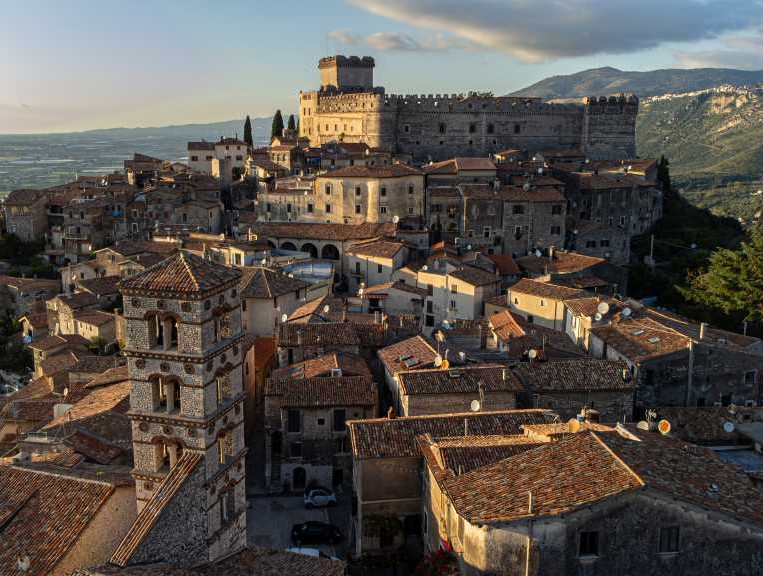
1. Caetani Castle

Caetani Castle dates back to the 13th century. Over its long history, this splendid fortress has withstood attacks and wars, hosting notable figures and witnessing centuries of events. It stands […]
Discover more

2. Elms Square

Elms Square can be considered a fortified outer courtyard built for defensive purposes. The square takes its name from the elm trees that once shaded this area; the last one […]
Discover more

3. First Drawbridge

The first drawbridge served as the main defensive entrance to the castle’s inner courtyard. The timber bridge connected the outer fortifications to the central core and could be quickly raised […]
Discover more

4. Second drawbridge

Beneath the Casa del Cardinale lies the large stable, characterised by a barrel vault, cobbled floors, and troughs for fodder. The column at the top of the sloping ramp leading […]
Discover more

5. Saint Barbara Chapel

The Cappella di Santa Barbara is dedicated to the patron saint of soldiers and artillerymen, invoked for protection against the dangers of weapons and explosions. Its presence at the heart […]
Discover more

6. The Maschio Tower

The Maschio Tower is the main tower of Caetani Castle, a symbol of power and defence. Built in the mid-13th century by the Annibaldi, it rises 42 metres above the […]
Discover more

7. The Maschietto Tower

The Maschietto Tower, or counter-tower, is a smaller defensive structure attached to the southern side of the Maschio Tower. Built using the same construction technique, it was erected after the […]
Discover more

8. The French Prisons

Within Caetani Castle lies a striking space: the French Prisons. Located on the raised floors of the Maschio and the Maschietto Towers, these rooms testify to the castle’s military and […]
Discover more

9. Place of Arms

The Place of Arms forms the heart of the castle. It lies as a quadrangular inner courtyard, reached by ascending past two drawbridges. It sits above a large tank carved […]
Discover more

10. Area of the Church of San Pietro in Corte

The small church was likely built during the Middle Ages, near the Belvedere Tower. Today, only a few fragments remain: some 10th–11th century capitals scattered throughout the castle, along with […]
Discover more

11. Cardinal’s house

The Cardinal’s house, built during the brief Borgia period in the early 16th century, is the only building in the castle specifically intended as a residence. The house was designed […]
Discover more

12. Kitchen

The castle kitchen was one of the most vital spaces, designed to meet the needs of a large household and high-ranking guests.  Located near the reception rooms, it consisted of […]
Discover more

13. Hall of the Barons

The great Sala dei Baroni is among the most imposing work carried out by the Caetani in the early 14th century. Located adjacent to the Maschio Tower and now known […]
Discover more

14. Room of the Nymphs

The Stanza delle Ninfe, part of the Painted Rooms of the Caetani Castle, exemplifies the late-15th-century taste for classical mythology. Its walls are decorated with frescoes depicting female figures in […]
Discover more

15. Stanza delle virtù – Camere Pinte

Nella Stanza delle Virtù l’arte diventa manifesto morale e politico. Gli affreschi raffigurano, secondo la tradizione medievale, personificazioni delle Virtù – Prudenza, Giustizia, Fortezza e Temperanza – rappresentate con attributi iconografici […]
Discover more

16. Servants’ Quarters

The servants’ quarters housed the staff responsible for the castle’s daily life. They were generally located on the lower floors or in more secluded areas, reflecting both the social hierarchy […]
Discover more

17. Bedroom

In the early 20th century, Gelasio Caetani renovated the large hall on the first floor of the Maschio Tower, converting it into the Duke’s bedroom. The room became the lord’s […]
Discover more

18. Bedroom

In the early 20th century, Gelasio Caetani renovated the large hall on the first floor of the Maschio Tower, converting it into the Duke’s bedroom. The room became the lord’s […]
Discover more

19. Belvedere Tower

Thanks to its strategic position, the Torre del Belvedere allowed control of the communication routes toward Rome and Naples, and it still offers breathtaking views that captivate visitors today. The […]
Discover more

20. Outer wall walk

The outer wall walk runs along part of the external defensive circuit and offers a strategic vantage point over the surrounding territory. It was used to monitor enemies and coordinate […]
Discover more

21. Inner wall walk

The inner wall walk runs along a section of the castle’s curtain walls, between the Torre di Ponente (West Tower) and the Torre del Belvedere. It allowed control of the […]
Discover more

22. Stables

Beneath the Casa del Cardinale lies the large stable, characterised by a barrel vault, cobbled floors, and troughs for fodder.  The column at the top of the sloping ramp leading […]
Discover more

23. Cellar

Below the Casa del Cardinale, on the western side of the fortress, lies a large room that once served as the castle’s cellar. This function is documented from the 15th […]
Discover more

24. Gendarmes’ Hall

This space was intended for the armed garrison responsible for guarding the castle and protecting the Caetani family, particularly during periods marked by political tension and territorial conflicts.  During the […]
Discover more

25. Prisons

The Caetani Castle prisons were austere, confined spaces used for the detention of common criminals and political opponents, reflecting the fortress’s military and custodial role. Located in the basement levels, […]
Discover more